Your 4th money laundering directive key changes images are available in this site. 4th money laundering directive key changes are a topic that is being searched for and liked by netizens now. You can Find and Download the 4th money laundering directive key changes files here. Get all royalty-free photos and vectors.
If you’re searching for 4th money laundering directive key changes images information linked to the 4th money laundering directive key changes interest, you have come to the ideal blog. Our site always provides you with hints for seeing the highest quality video and image content, please kindly hunt and locate more informative video content and images that match your interests.
4th Money Laundering Directive Key Changes. The amendments to the current regime are not extensive and the European Commission has said it does not expect firms to be unduly impacted by the new changes. There will no longer be automatic exemptions from conducting client due diligence. The 5th Money Laundering Directive 1 5MLD came into force on the 10th January 2020. Member states are required to transpose 6AMLD into national law by 3 December 2020.
 Eu Policy On High Risk Third Countries European Commission From ec.europa.eu
The 4th EU Money Laundering Directive Key Requirements Money laundering is an issue that allows corrupt individuals to legitimise their illegal activities. 4th Money Laundering Directive Key Changes and how it will impact you The new Fourth Money Laundering Directive EU 2015849 was passed by the EU in June 2015 and will be implemented in the UK by June 2017. The Risk-Based Approach The risk-based approach is a mechanism guiding the implementation of requirements as set out in the Directive. The changes will come into force by 30 June 2017. EU Member States have to implement the 4th AMLD by 26 June 2017 into national law. It came into force on 25 June 2015 and member states must implement the required changes in their domestic legislation by 26 June 2017.
It came into force on 25 June 2015 and member states must implement the required changes in their domestic legislation by 26 June 2017.
The Directive will come into force on 10th January 2020 and contains enhancements to the existing provisions as mandated by the EUs 4th Money Laundering Directive 4MLD which was implemented in the UK through the Money Laundering Regulations 2017. The EU 6AMLD continues to extend and strengthen measures to combat anti-money laundering across member states. Implementing the Fourth Money Laundering Directive Following a consultation exercise that ran between September and November 2016 the UK Government has now set out its proposals for changes to the UK Anti-Money laundering regime in order to implement the Fourth Money Laundering Directive 4MLD. The ultimate beneficial owner of a corporate client will need to be determined and due diligence checks performed. The changes will come into force by 30 June 2017. 5MLD is set to build on the regulatory requirements under the 4th Money Laundering Directive 2 4MLD.
 Source: vinciworks.com
Rachpal Thind and Kai Zhang of Sidley Austin LLP discuss the key changes proposed and what they mean for service. Risk based approach The AMLCTF rules of the Crown Dependencies have mandated a risk based approach to due diligence for a number of years. MLD4 replaces the Third Money Laundering Directive MLD3 and places greater focus on the use by firms of a risk-based approach in relation to AML and CTF. The 4th EU Money Laundering Directive Key Requirements Money laundering is an issue that allows corrupt individuals to legitimise their illegal activities. The Fourth Anti-Money Laundering Directive 2015849EU the Directive is the most significant of these legislative changes to affect EU member states see box Serious Crime Act 2015.
 Source: tookitaki.ai
The main proposed changes as implemented by the 4th AML Directive are outlined below. EU Member States have to implement the 4th AMLD by 26 June 2017 into national law. On 26 June 2015 the 4th Anti-Money Laundering Directive EU No. The Directive will come into force on 10th January 2020 and contains enhancements to the existing provisions as mandated by the EUs 4th Money Laundering Directive 4MLD which was implemented in the UK through the Money Laundering Regulations 2017. The 4th AMLD recasts the existing 3rd Anti-Money Laundering Directive Directive 200560EU and the corresponding Implementing Directive Commission Directive.
 Source: bankinghub.eu
As most EU member states have completed the transposition of the Fourth Money Laundering Directive 4MLD into their national law there are some key differences to be aware of. Rachpal Thind and Kai Zhang of Sidley Austin LLP discuss the key changes proposed and what they mean for service. Risk based approach The AMLCTF rules of the Crown Dependencies have mandated a risk based approach to due diligence for a number of years. It came into force on 25 June 2015 and member states must implement the required changes in their domestic legislation by 26 June 2017. This issue occurs consistently in the worlds most prestigious institutions perpetrated by the worlds most prestigious individuals.
 Source: encompasscorporation.com
2 Jun 2021. The ultimate beneficial owner of a corporate client will need to be determined and due diligence checks performed. CDD Simplified CDD will no longer be applicable in most circumstances. Risk based approach The AMLCTF rules of the Crown Dependencies have mandated a risk based approach to due diligence for a number of years. Those who violate 4AMLDs provisions will face a maximum fine of at least twice the amount of the benefit derived from the breach or at least 1 million.
 Source: acamstoday.org
Key changes The European Commission published the Fourth Money Laundering Directive and the new W ir eT a ns fR gul to w hc enacted will impact online financial service and payments services providers. The Directive will come into force on 10th January 2020 and contains enhancements to the existing provisions as mandated by the EUs 4th Money Laundering Directive 4MLD which was implemented in the UK through the Money Laundering Regulations 2017. This issue occurs consistently in the worlds most prestigious institutions perpetrated by the worlds most prestigious individuals. The amendments to the current regime are not extensive and the European Commission has said it does not expect firms to be unduly impacted by the new changes. The relevant regulations must be implemented by regulated entities within member states by 3 June 2021.
 Source: ccmalta.com
The purpose of 5MLD is to strengthen the UKs financial system in order to prevent criminals laundering money and funding terrorism. CDD Simplified CDD will no longer be applicable in most circumstances. The Risk-Based Approach The risk-based approach is a mechanism guiding the implementation of requirements as set out in the Directive. The relevant regulations must be implemented by regulated entities within member states by 3 June 2021. It came into force on 25 June 2015 and member states must implement the required changes in their domestic legislation by 26 June 2017.
 Source: bankinghub.eu
Key Changes Within The Fourth EU Money Laundering Directive Compliance The Fourth EU Money Laundering Directive 4MLD which came into force on June 26 2015 is designed to bring a more robust risk-based approach to the prevention of money laundering and terrorist financing across all. MLD4 replaces the Third Money Laundering Directive MLD3 and places greater focus on the use by firms of a risk-based approach in relation to AML and CTF. The main proposed changes as implemented by the 4th AML Directive are outlined below. The 4th AMLD recasts the existing 3rd Anti-Money Laundering Directive Directive 200560EU and the corresponding Implementing Directive Commission Directive. Some of the key changes that the Fourth Money Laundering Directive present are.
 Source: financialcrimes.vercel.app
Those who violate 4AMLDs provisions will face a maximum fine of at least twice the amount of the benefit derived from the breach or at least 1 million. The ultimate beneficial owner of a corporate client will need to be determined and due diligence checks performed. The sanctions for firms and individuals who dont comply with the Fourth Money Laundering Directive have also been updated and it is now mandatory for EU countries to impose these sanctions. On 26 June 2015 the 4th Anti-Money Laundering Directive EU No. The 4th AMLD recasts the existing 3rd Anti-Money Laundering Directive Directive 200560EU and the corresponding Implementing Directive Commission Directive.
 Source: lavenpartners.com
MLD4 replaces the Third Money Laundering Directive MLD3 and places greater focus on the use by firms of a risk-based approach in relation to AML and CTF. As most EU member states have completed the transposition of the Fourth Money Laundering Directive 4MLD into their national law there are some key differences to be aware of. The EU 6AMLD continues to extend and strengthen measures to combat anti-money laundering across member states. The 4th EU Money Laundering Directive. This issue occurs consistently in the worlds most prestigious institutions perpetrated by the worlds most prestigious individuals.
 Source: slideshare.net
2015849 4th AMLD entered into force. Those who violate 4AMLDs provisions will face a maximum fine of at least twice the amount of the benefit derived from the breach or at least 1 million. It came into force on 25 June 2015 and member states must implement the required changes in their domestic legislation by 26 June 2017. 2015849 4th AMLD entered into force. As most EU member states have completed the transposition of the Fourth Money Laundering Directive 4MLD into their national law there are some key differences to be aware of.
 Source: camsafroza.com
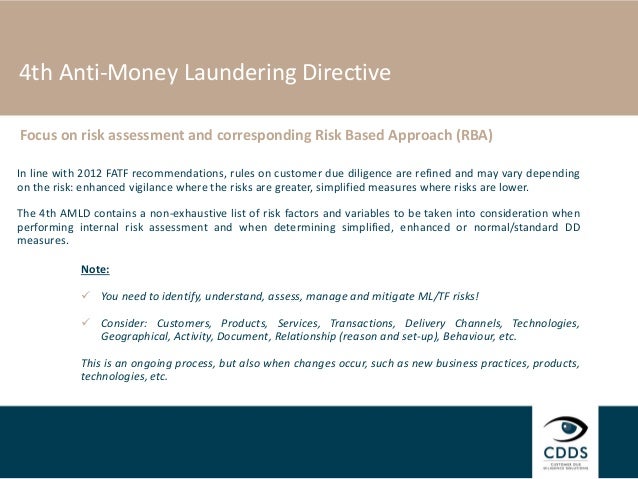
The EU 6AMLD continues to extend and strengthen measures to combat anti-money laundering across member states. The changes are important for the regulated sector given the increasing focus on AML compliance. The Fourth Anti-Money Laundering Directive 2015849EU the Directive is the most significant of these legislative changes to affect EU member states see box Serious Crime Act 2015. The 4th AMLD recasts the existing 3rd Anti-Money Laundering Directive Directive 200560EU and the corresponding Implementing Directive Commission Directive. The Risk-Based Approach The risk-based approach is a mechanism guiding the implementation of requirements as set out in the Directive.
 Source: skillcast.com
The sanctions for firms and individuals who dont comply with the Fourth Money Laundering Directive have also been updated and it is now mandatory for EU countries to impose these sanctions. 2 Jun 2021. As most EU member states have completed the transposition of the Fourth Money Laundering Directive 4MLD into their national law there are some key differences to be aware of. The Fourth Anti-Money Laundering Directive 2015849EU the Directive is the most significant of these legislative changes to affect EU member states see box Serious Crime Act 2015. 2015849 4th AMLD entered into force.
Source: ec.europa.eu
CDD Simplified CDD will no longer be applicable in most circumstances. MLD4 replaces the Third Money Laundering Directive MLD3 and places greater focus on the use by firms of a risk-based approach in relation to AML and CTF. The 4th EU Money Laundering Directive Key Requirements Money laundering is an issue that allows corrupt individuals to legitimise their illegal activities. Rachpal Thind and Kai Zhang of Sidley Austin LLP discuss the key changes proposed and what they mean for service. The current draft of the fourth Anti-Money Laundering Directive makes some significant changes to the current European AML regime and it will also impact how money laundering and terrorist financing MLTF risks are managed.
This site is an open community for users to do submittion their favorite wallpapers on the internet, all images or pictures in this website are for personal wallpaper use only, it is stricly prohibited to use this wallpaper for commercial purposes, if you are the author and find this image is shared without your permission, please kindly raise a DMCA report to Us.
If you find this site beneficial, please support us by sharing this posts to your favorite social media accounts like Facebook, Instagram and so on or you can also bookmark this blog page with the title 4th money laundering directive key changes by using Ctrl + D for devices a laptop with a Windows operating system or Command + D for laptops with an Apple operating system. If you use a smartphone, you can also use the drawer menu of the browser you are using. Whether it’s a Windows, Mac, iOS or Android operating system, you will still be able to bookmark this website.


