Your Bsaaml for non banking institutions images are ready in this website. Bsaaml for non banking institutions are a topic that is being searched for and liked by netizens now. You can Find and Download the Bsaaml for non banking institutions files here. Get all royalty-free vectors.
If you’re looking for bsaaml for non banking institutions pictures information connected with to the bsaaml for non banking institutions interest, you have come to the ideal blog. Our website frequently gives you hints for refferencing the highest quality video and picture content, please kindly surf and locate more enlightening video articles and images that fit your interests.
Bsaaml For Non Banking Institutions. Identify areas where improvements are needed. Risks Associated with Money Laundering and Terrorist Financing. Although the AML requirements in the BSA do not apply to companies other than financial institutions all companies operating in the US. While nonbanking companies are generally not regulated for BSAAML and sanctions compliance to the same degree that banks are they are widely perceived as vulnerable to illicit activity and therefore subject to significant.
 Bank Secrecy Act Anti Money Laundering Examination Manual U S Government Bookstore From bookstore.gpo.gov
It is also known as money-laundering act or jointly referred to as BSAAML. On July 15 2009 the Financial Crimes Enforcement Network FinCEN issued an advance notice of proposed rulemaking ANPRM to solicit public comment pertaining to the possible application of anti-money laundering AML program and suspicious activity report SAR regulations to a specific sub-set of loan and finance companies. Services include transaction monitoring alert backlog. These apply broadly and can potentially result in. The OCC conducts regular examinations of national banks federal savings associations federal branches and agencies of foreign banks in the US. AML laws date back to 1970 when Congress passed the Currency and Foreign Transactions Reporting Act commonly known as the Bank Secrecy Act or the BSA which requires that banks and many other financial institutions file currency reports with the United.
We provide highly trained AMLBSA professionals to assist banks and non-bank financial institutions to meet day-to-day compliance tasks.
Review BSAAML compliance programs relative to an institutions risk profile. Assess the adequacy of the banks systems to manage the risks associated with accounts of nonbank financial institutions NBFI and managements ability to implement. AML laws date back to 1970 when Congress passed the Currency and Foreign Transactions Reporting Act commonly known as the Bank Secrecy Act or the BSA which requires that banks and many other financial institutions file currency reports with the United. Each identified high risk entity that is a NBFI should be reviewed quarterly for activity that would. Services include transaction monitoring alert backlog. The principal elements of an AML compliance program are as follows.
 Source: pinterest.com
Non-bank residential mortgage lenders and originators Non-Bank. Every community bank faces some degree of inherent Bank Secrecy ActAnti-Money Laundering BSAAML risk. The Bank Secrecy Act BSA was originally enacted in 1970 and subsequently amended many times. Non-bank residential mortgage lenders and originators Non-Bank. Risks Associated with Money Laundering and Terrorist Financing.
Source: bookstore.gpo.gov
Examination of adherence to BSAAML laws and regulations applicable to regulated financial institutions or non-bank financial institutions. This inherent risk comes from a banks products and services customers and entities and the geographical locations in which the institution and its customers operate. Risks Associated with Money Laundering and Terrorist Financing. The financial institutions are also required to report any suspicious activity that may show any signs of money laundering tax evasion etc. The Bank Secrecy Act BSA was originally enacted in 1970 and subsequently amended many times.
 Source: pinterest.com
An effective BSA-AML compliance program should suit the unique needs of the financial institution it serves including the risk profile it faces. This inherent risk comes from a banks products and services customers and entities and the geographical locations in which the institution and its customers operate. Examination of adherence to BSAAML laws and regulations applicable to regulated financial institutions or non-bank financial institutions. The Bank Secrecy Act authorizes the Secretary of the Treasury to require financial institutions to keep records and file reports that have a high degree of usefulness in criminaltax or regulatory investigations or in the conduct of intelligence or counterintelligence activities relating to international terrorismThis has excluded non-bank RMLOs until recently. While nonbanking companies are generally not regulated for BSAAML and sanctions compliance to the same degree that banks are they are widely perceived as vulnerable to illicit activity and therefore subject to significant.
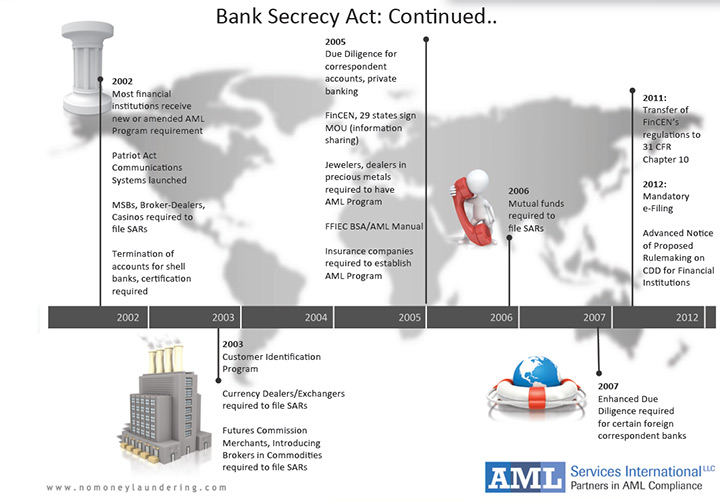 Source: acamstoday.org
Nonbank Financial Institutions Overview FFIEC BSAAML Examination Manual 299 2272015V2 Nonbank Financial Institutions Overview Objective. On July 15 2009 the Financial Crimes Enforcement Network FinCEN issued an advance notice of proposed rulemaking ANPRM to solicit public comment pertaining to the possible application of anti-money laundering AML program and suspicious activity report SAR regulations to a specific sub-set of loan and finance companies. The principal elements of an AML compliance program are as follows. The OCC conducts regular examinations of national banks federal savings associations federal branches and agencies of foreign banks in the US. Review BSAAML compliance programs relative to an institutions risk profile.
 Source: pinterest.com
The OCC conducts regular examinations of national banks federal savings associations federal branches and agencies of foreign banks in the US. The BSA requires financial institutions to each develop an Anti Money Laundering AML program. Must comply with the principal US. To be compliant with BSA requirements banks should also monitor transactions for Non- Bank Financial Institution NBFI and Money Services Business MSB customers. Examination of adherence to BSAAML laws and regulations applicable to regulated financial institutions or non-bank financial institutions.
 Source: pinterest.com
It is also known as money-laundering act or jointly referred to as BSAAML. While nonbanking companies are generally not regulated for BSAAML and sanctions compliance to the same degree that banks are they are widely perceived as vulnerable to illicit activity and therefore subject to significant. We provide highly trained AMLBSA professionals to assist banks and non-bank financial institutions to meet day-to-day compliance tasks. Although the AML requirements in the BSA do not apply to companies other than financial institutions all companies operating in the US. Review BSAAML compliance programs relative to an institutions risk profile.
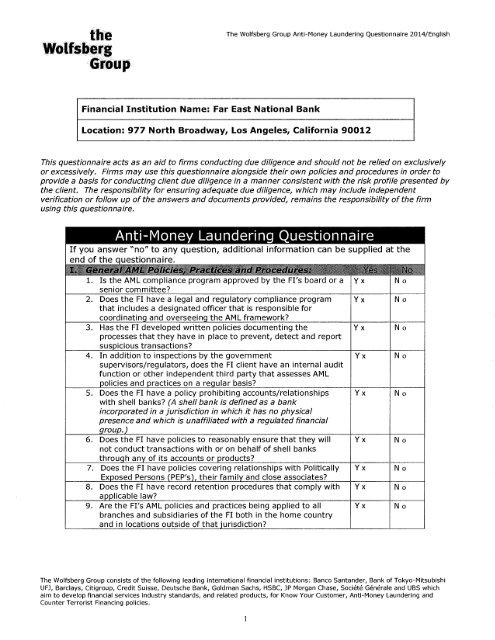 Source: yumpu.com
AML laws date back to 1970 when Congress passed the Currency and Foreign Transactions Reporting Act commonly known as the Bank Secrecy Act or the BSA which requires that banks and many other financial institutions file currency reports with the United. Nonbank Financial Institutions Overview FFIEC BSAAML Examination Manual 299 2272015V2 Nonbank Financial Institutions Overview Objective. Services include transaction monitoring alert backlog. The Bank Secrecy Act authorizes the Secretary of the Treasury to require financial institutions to keep records and file reports that have a high degree of usefulness in criminaltax or regulatory investigations or in the conduct of intelligence or counterintelligence activities relating to international terrorismThis has excluded non-bank RMLOs until recently. Risks Associated with Money Laundering and Terrorist Financing.
 Source: businesslawtoday.org
AML RightSource is the leading firm solely focused on Anti-Money Laundering AMLBank Secrecy Act BSA and financial crimes compliance solutions. Each identified high risk entity that is a NBFI should be reviewed quarterly for activity that would. Identify areas where improvements are needed. To determine compliance with the BSA. Risks Associated with Money Laundering and Terrorist Financing.
 Source: pinterest.com
Review BSAAML compliance programs relative to an institutions risk profile. The joint statement sets forth the agencies policy on the circumstances in which an agency will issue a mandatory cease and desist order to address non-compliance with the BSA. Examination of adherence to BSAAML laws and regulations applicable to regulated financial institutions or non-bank financial institutions. Services include transaction monitoring alert backlog. Although the AML requirements in the BSA do not apply to companies other than financial institutions all companies operating in the US.
 Source: pinterest.com
The financial institutions are also required to report any suspicious activity that may show any signs of money laundering tax evasion etc. Published on June 17 2016 June 17 2016 4 Likes 0 Comments. Although the AML requirements in the BSA do not apply to companies other than financial institutions all companies operating in the US. Nonbank Financial Institutions Overview FFIEC BSAAML Examination Manual 299 2272015V2 Nonbank Financial Institutions Overview Objective. Non-bank residential mortgage lenders and originators Non-Bank.
 Source: pinterest.com
It is also known as money-laundering act or jointly referred to as BSAAML. AML laws date back to 1970 when Congress passed the Currency and Foreign Transactions Reporting Act commonly known as the Bank Secrecy Act or the BSA which requires that banks and many other financial institutions file currency reports with the United. AML laws 18 USC. On August 13 federal banking agencies namely the Federal Reserve the Federal Deposit Insurance Corporation the National Credit Union Administration and the Office of the Comptroller of the Currency issued a Joint Statement on Enforcement of Bank Secrecy ActAnti-Money Laundering Requirements. The OCC uses informal and formal enforcement actions to.
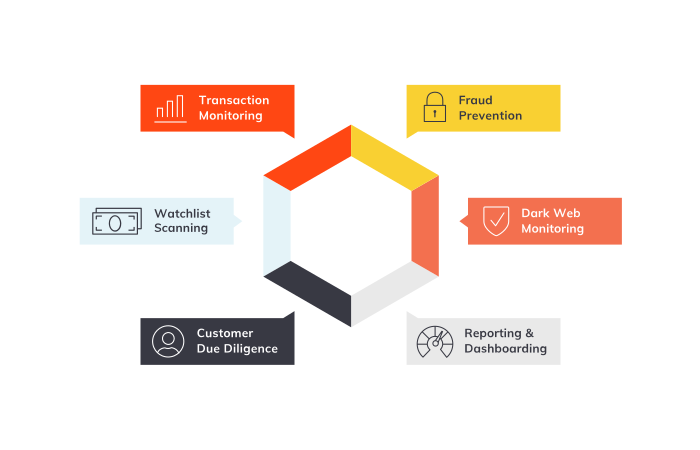 Source: abrigo.com
Assess the adequacy of the banks systems to manage the risks associated with accounts of. Assess the adequacy of the banks systems to manage the risks associated with accounts of nonbank financial institutions NBFI and managements ability to implement. Risks Associated with Money Laundering and Terrorist Financing. Every community bank faces some degree of inherent Bank Secrecy ActAnti-Money Laundering BSAAML risk. Review of agencys detailed written reports of deficiencies.
 Source: pinterest.com
Every community bank faces some degree of inherent Bank Secrecy ActAnti-Money Laundering BSAAML risk. To determine compliance with the BSA. AML laws 18 USC. Although the AML requirements in the BSA do not apply to companies other than financial institutions all companies operating in the US. The financial institutions are also required to report any suspicious activity that may show any signs of money laundering tax evasion etc.
This site is an open community for users to share their favorite wallpapers on the internet, all images or pictures in this website are for personal wallpaper use only, it is stricly prohibited to use this wallpaper for commercial purposes, if you are the author and find this image is shared without your permission, please kindly raise a DMCA report to Us.
If you find this site value, please support us by sharing this posts to your own social media accounts like Facebook, Instagram and so on or you can also bookmark this blog page with the title bsaaml for non banking institutions by using Ctrl + D for devices a laptop with a Windows operating system or Command + D for laptops with an Apple operating system. If you use a smartphone, you can also use the drawer menu of the browser you are using. Whether it’s a Windows, Mac, iOS or Android operating system, you will still be able to bookmark this website.


